
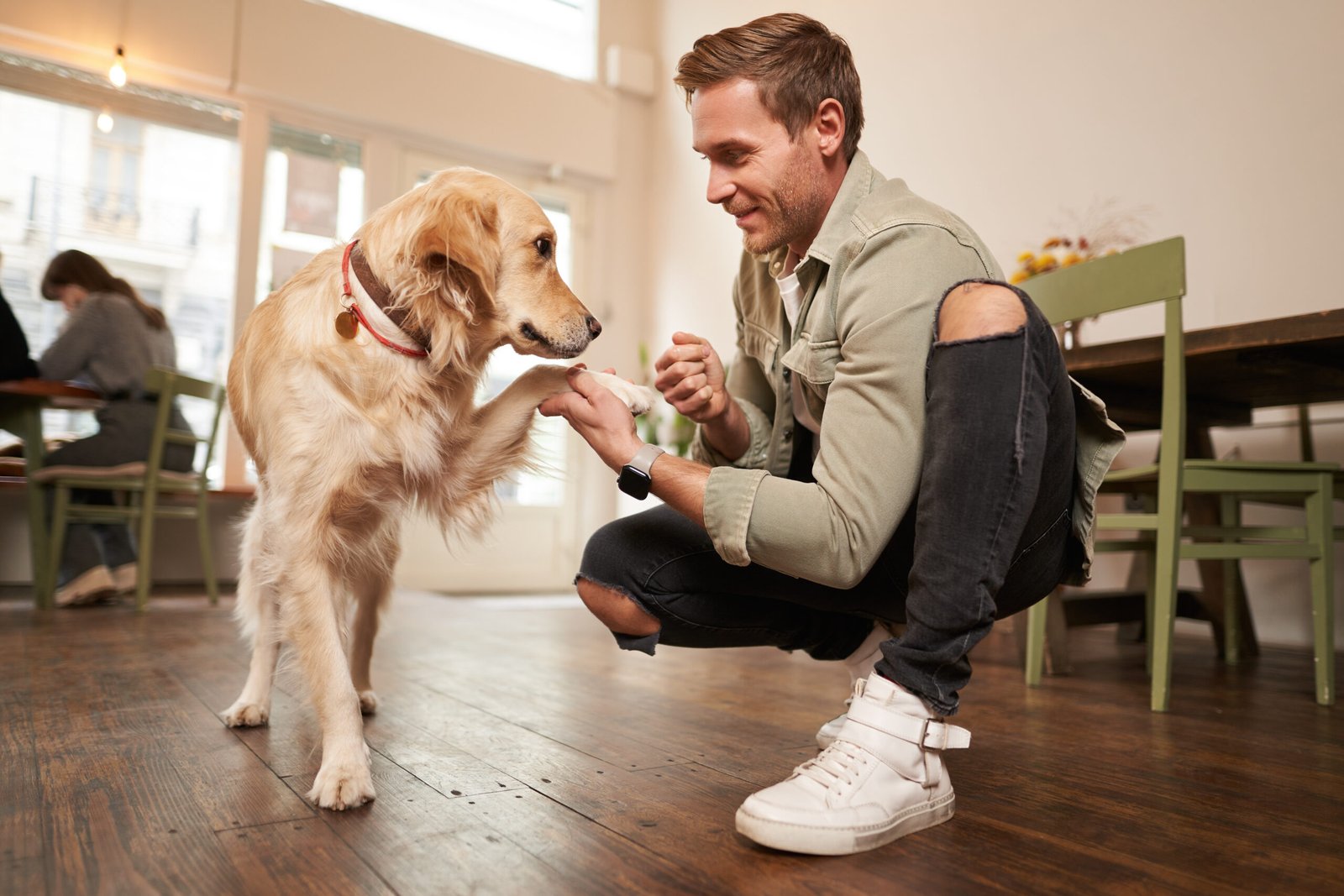
You’ve learned to read the bark. The low rumble that means “there’s something outside.” The high-pitched yip that means “I’m so excited I might levitate.” The slow, spaced-out woof that means “hello? Is anyone home?”
But here’s the thing — barking is actually one of the noisiest, most obvious signals your dog sends. The subtler, more constant conversation is happening silently, all day long, through their ears, eyes, mouth, posture, and the tension (or total lack of it) in every muscle of their body.
Dogs communicate in full sentences. Most of us only catch the punctuation marks — the growl, the tail wag, the excited spin. Learning to read the quieter signals in between changes everything about how you understand your dog — and how your dog feels understood by you.
Here’s what they’re actually saying.
Ears are one of the fastest and most honest indicators of a dog’s emotional state — and because ear shapes vary so dramatically across breeds, they’re also one of the most commonly misread.
When a dog’s ears shift forward — toward whatever has caught their attention — it signals alertness and active focus. The dog is gathering information: Who is that? What is that smell? Is this something I need to respond to? This is a neutral-to-positive signal on its own, but context matters. Forward ears paired with a relaxed body mean curiosity. Forward ears paired with a stiff body and hard gaze mean something else entirely.
Ears pulled tight and flat is almost always a sign of fear, anxiety, or submission. The dog is making themselves smaller and signalling that they mean no threat. You’ll often see this at the vet, during loud noises, or when a dog is being approached by someone or something they find intimidating. It’s a please-don’t-hurt-me signal, not a bad-dog signal — and it deserves a calm, reassuring response, not a correction.
This is the ear position that tends to get overlooked precisely because it looks like nothing much. Loose, soft, slightly dropped ears are the signal of a genuinely comfortable dog. No threat detected. No need to be on alert. Just a dog at ease in their environment. If you see this after an anxious period, you’ll know your dog has settled.
Breeds like Basset Hounds, Cocker Spaniels, and Labradors have limited ear mobility, which makes reading their ear signals trickier — but not impossible. Even a floppy ear can shift slightly forward with alertness or pull closer to the head with anxiety. The changes are subtler, which means you’ll need to watch the whole body even more carefully.
Research has shown that dogs have evolved a specific facial muscle — not present in wolves — that allows them to raise their inner brow and make their eyes appear larger and more expressive when looking at humans.
Soft, slightly squinting eyes with no visible tension around the socket mean a relaxed, content dog. When your dog looks at you with this expression — slow blink, heavy lids, no hard focus — that’s the dog equivalent of a genuine, warm smile. It’s one of the most satisfying signals to learn to recognise, because once you do, you’ll start noticing it constantly.
A dog whose eyes have gone very still, very fixed, and very deliberate is a dog in a heightened state. Hard, unblinking eye contact directed at a person or another animal is a warning signal — not aggression yet, but a clear communication that the dog is uncomfortable and asking the other party to back off. In dog social language, prolonged direct eye contact is a challenge, not a greeting.
This is the term used when you can see a visible crescent of white around the iris — the dog has turned their head away while keeping their eyes fixed on the source of their discomfort, which exposes the white of the eye. Whale eye is a stress signal and often precedes a snap or a bite when ignored. It shows up most commonly when a dog is being hugged, when something is being taken from them, or when they’re cornered.
That little lift of the inner brow your dog does when they’re looking at you? It’s not accidental. Research has confirmed that dogs have evolved a specific muscle for exactly this expression — one not present in wolves — that produces a look resembling the human expression of sadness or concern. Dogs use it deliberately when making eye contact with their owners, and humans respond to it powerfully. It’s a piece of co-evolutionary biology that has deepened the bond between the species for thousands of years.
A mouth that hangs open softly, with the tongue lolling out and no tension in the jaw, belongs to a happy, comfortable dog. This is the “smiling dog” expression that photographs so well — and it’s genuinely meaningful. The looseness is the tell. Everything relaxed, everything soft.
When a dog suddenly closes their mouth — particularly during an interaction that was fine a moment ago — pay attention. A closed, tight mouth is often one of the first signs of rising tension. The dog is bracing, reassessing, deciding something. It can be a precursor to a growl or a snap. If you see this while someone is petting your dog and the dog’s mouth goes from open and relaxed to closed and still, that’s the moment to create space.
Both of these are what behaviourists call “calming signals” — actions dogs use to communicate that they are uncomfortable and trying to de-escalate a situation. A dog who licks their lips repeatedly when someone approaches them is not tasting something delicious. A dog who yawns elaborately mid-interaction is not tired. Both signals say: I’m feeling pressure and I’d like this to ease up. Once you start noticing them, you’ll see them constantly — during training sessions, at greetings, when children get too close.
Some dogs pull their lips back to expose their front teeth in a way that looks disturbingly like a snarl but is actually the opposite — a greeting gesture, often accompanied by squinting eyes, a low body posture, and an enthusiastic wag. It’s more common in some breeds and individuals than others, and it tends to confuse people who haven’t seen it before. Context and the rest of the body are everything: a submissive grin is accompanied by softness. A true snarl is accompanied by tension.
A dog whose weight has shifted forward — chest leading, body leaning toward whatever has caught their attention — is a dog moving into engagement mode. This can be play-driven curiosity or predatory interest, depending on the target and the context. Paired with a loose, wiggly body: excitement. Paired with stillness and stiff posture: an intent that warrants watching.
A dog who drops their weight backward, makes themselves low, or tucks into a crouching position is communicating discomfort, uncertainty, or fear. This is different from the play bow — where the front end goes down and the rear stays up in an invitation to play — which is accompanied by a looseness and energy that’s unmistakable once you’ve seen it.
The hackles — the fur along the ridge of the back and neck — rising involuntarily is a physiological response to arousal, not purely aggression. Dogs raise their hackles when they’re frightened, overly excited, or highly stimulated, as well as when they feel threatened. A dog with raised hackles is a dog whose nervous system is in a heightened state. That alone doesn’t tell you what they’ll do next — which is why reading the rest of the body alongside it is essential.
The single clearest signal that a dog is genuinely at ease is a body with no tension anywhere: wiggly, floppy, a little bouncy, weight distributed casually, nothing held rigid. A loose dog is a happy dog. And once you learn to look for that quality of looseness — as a whole-body characteristic, not just a wagging tail — you’ll have the most useful single tool in your body language reading kit.
No signal exists in isolation. A raised hackle with a loose, wiggly body and an open mouth is very different from a raised hackle with a stiff body, closed mouth, and fixed gaze. A tail wagging with soft eyes and a bouncy posture is very different from a tail moving with a rigid body and tense face.
The skill — and it is a skill, one that improves with practice — is learning to read the whole picture simultaneously rather than one feature at a time. Dogs communicate in full-body compositions, not individual gestures. When you start seeing them that way, you stop reacting to the loudest signal in the room and start actually understanding what your dog is telling you.
And your dog, who has been talking all along, will finally feel like someone is listening.

Software Developer & Writer
Hey, I'm Diva, a developer and writer blending code and creativity. I'm driven by a deep curiosity and a relentless pursuit of excellence. Join me as I craft digital solutions and captivating stories.


Leave A Comment