
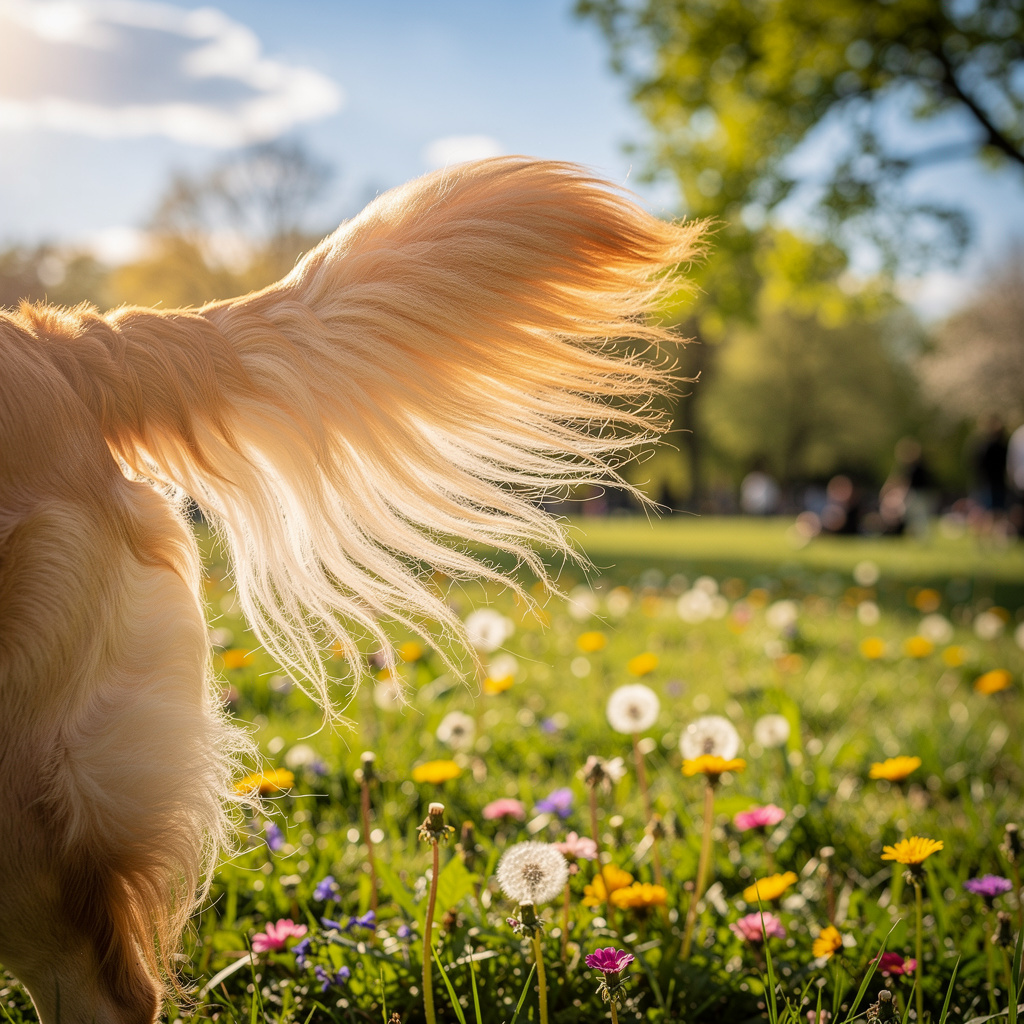
You walk through the front door after a long day and your dog’s tail starts going like a helicopter propeller. You smile, because of course you do — that wag means everything is right in the world.
But here’s the thing: not every wag means the same thing. That slow, low sweep your dog does when you approach their food bowl? That’s different from the stiff, rapid quiver they do when a stranger gets too close. And the tail that holds perfectly still when your dog spots a squirrel? That’s a whole other conversation.
Your dog’s tail is one of the most expressive communication tools in the animal kingdom — and learning to read it can genuinely change the way you relate to your dog. Let’s break it down.
Dogs don’t wag their tails at other dogs the way they do at humans. Puppies actually don’t wag at all during their first few weeks of life — the behaviour emerges as a social signal, something that develops as they begin interacting with others. That tells us something important: tail wagging is fundamentally communicative. It’s directed outward, at an audience.
But what’s being communicated depends on a surprising number of variables: the height of the tail, the speed of the wag, the direction it leans, and the tension in the tail itself. Taken together, these signals create a rich vocabulary that most of us have only scratched the surface of.
Before you even clock the wag, look at where the tail is being held in relation to your dog’s body. Tail position is one of the clearest indicators of emotional state.
A tail held high — above the level of the spine — signals confidence, alertness, and arousal. Your dog is engaged with their environment and feeling assertive. This can be excitement, but it can also be intensity. A dog on high alert, assessing a potential threat, will often carry their tail this way. It doesn’t necessarily mean aggression, but it’s worth paying attention to what else their body is doing.
A tail held roughly parallel to the ground indicates a relaxed, neutral dog. This is the tail of a dog just going about their day — investigating a scent, trotting through the park, checking in with you on a walk. It’s the baseline, and seeing it tells you your dog is comfortable.
A tail carried low, especially when tucked between the hind legs, signals anxiety, fear, or submission. Your dog is making themselves smaller, communicating that they pose no threat. This isn’t a sign of a “bad” dog — it’s a sign of a worried one. If you regularly see this posture, it’s worth exploring what’s causing your dog stress and speaking with a trainer or behaviourist.
Now for the part most people focus on — the wag. But not all wags are created equal.
A broad, sweeping wag — especially one that gets the whole rear end involved — is generally a sign of enthusiastic, positive emotion. When your dog greets you at the door with their entire body wiggling, there’s no ambiguity there. That’s joy. The wider and more full-body the movement, the more uninhibited the emotion behind it.
A slow wag can mean a dog is uncertain, cautious, or carefully sizing up a situation. You might see this when your dog encounters an unfamiliar person or animal. They’re not unhappy, but they’re not fully comfortable either. They’re gathering information before committing to a response.
A tight, rapid vibration — rather than a true back-and-forth sweep — is worth noting carefully. This kind of wag often accompanies high arousal and can signal that a dog is on the edge of reacting. Paired with a raised tail, stiff body posture, and hard eye contact, it can be a precursor to a defensive response. This is one of those moments where the wag can genuinely mislead people who assume all wags mean friendliness.
Here’s where it gets really fascinating. Research published in Current Biology found that dogs actually wag more to the right when they encounter something positive — like their owner — and more to the left when they’re faced with something that triggers anxiety or uncertainty. The asymmetry is subtle enough that it’s hard to detect with the naked eye, but it’s measurable, and other dogs can read it.
In a follow-up study, dogs shown video of other dogs wagging to the left showed elevated heart rates and anxious behaviour. Dogs shown right-biased wags stayed calm. This tells us that even among dogs, the details of a wag carry real information — they’re not just reacting to the fact of the wag, but to its specific character.
It’s a reminder that what looks like a simple gesture is actually a layered communication system shaped by millions of years of social evolution.
Dogs with docked tails, naturally bobbed tails, or extremely curled tails (like the Basenji’s tight curl or the Pug’s corkscrew) face a genuine communication challenge. Research suggests that other dogs find these dogs harder to read and may be more likely to approach them cautiously or react poorly to them — not because of the dogs themselves, but because the visual signal is missing or distorted.
If you have a short-tailed or naturally bobbed dog, it’s worth being extra mindful in social situations. Pay attention to how other dogs respond to your pup, and step in to give everyone space if interactions seem tense.
As useful as tail signals are, they’re always best read alongside the rest of your dog’s body. A tail wag paired with relaxed ears, a soft mouth, and a loose body tells a completely different story than the same wag paired with stiff posture, raised hackles, and a hard stare.
Think of the tail as one instrument in an orchestra. It contributes to the overall sound, but to really understand the music, you need to listen to all of them together. Over time, as you tune into your dog’s full range of signals — their posture, their facial expressions, their vocalizations, their breathing — you start to hear the music clearly. And your dog, who has been talking all along, will finally feel truly understood.
High tail, fast wag, loose body → Excited, happy, confident
Level tail, steady wag, relaxed face → Content and comfortable
Low tail, slow wag, soft posture → Uncertain, a little nervous, seeking reassurance
High tail, stiff short wag, rigid body → Aroused, on alert — proceed carefully
Tail tucked, no wag, crouched posture → Fearful or very stressed — give space and comfort
Tail wagging right-biased → Likely a positive, approaching emotion
Tail wagging left-biased → Likely a cautious or anxious emotional state
The next time your dog wags at you, take a second look. Are they sweeping wide and low? Holding high and quivering? Letting the whole back half of their body get in on it? Every one of those variations is a word in a language they’ve been speaking their whole lives.
Once you start listening, you’ll be amazed by how much they’ve been trying to say.

Software Developer & Writer
Hey, I'm Diva, a developer and writer blending code and creativity. I'm driven by a deep curiosity and a relentless pursuit of excellence. Join me as I craft digital solutions and captivating stories.


Leave A Comment