
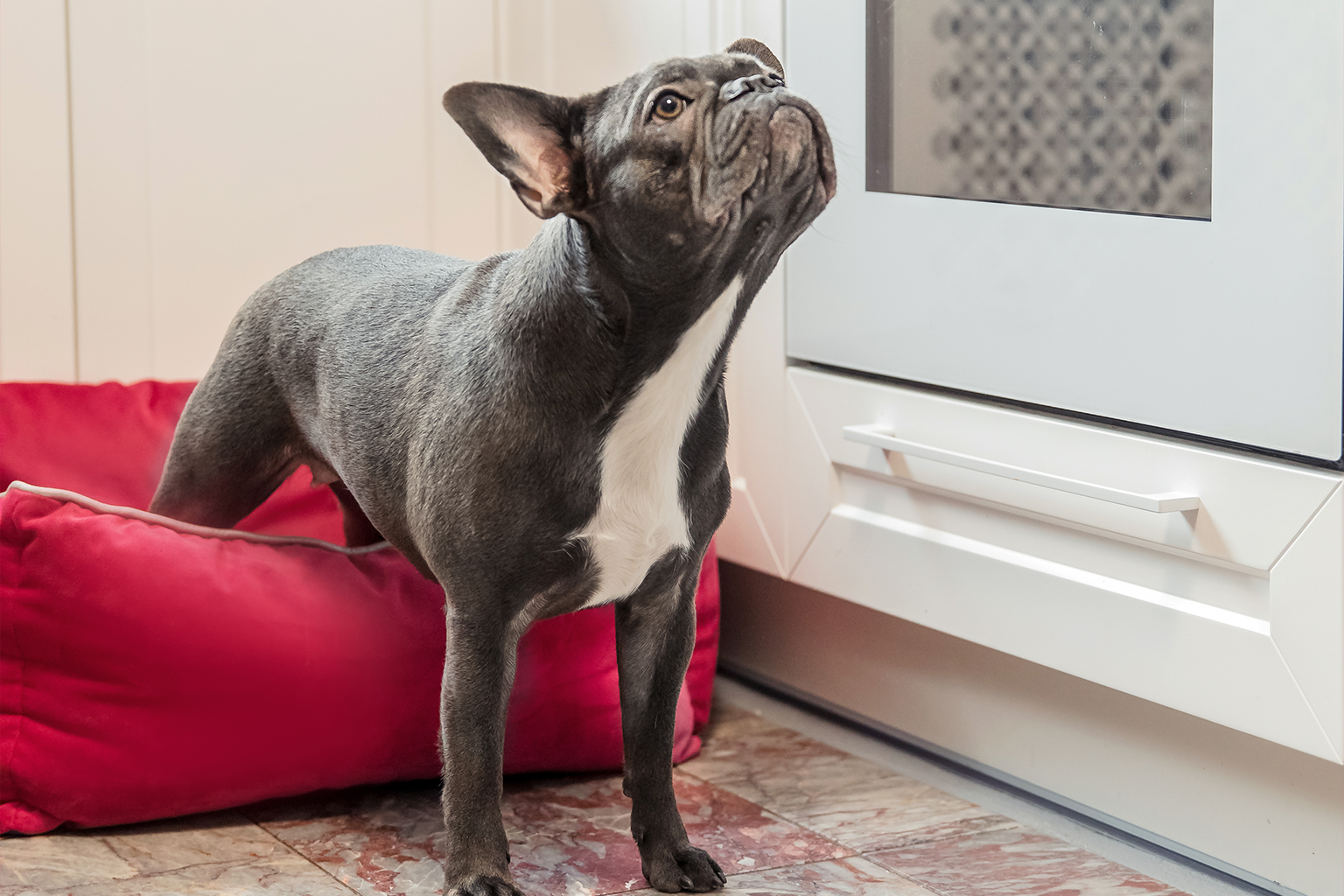
You walk into your home and see the sofa, the rug, the kitchen counter with last night’s dishes still on it. Your dog walks in behind you and experiences something closer to a detailed news broadcast — who has been here, when, what they ate, how they were feeling, and what happened in every corner of every room since the last time the door opened.
We share our homes with dogs. We do not share our experience of those homes. And understanding just how radically different their sensory world is from ours changes the way you think about everything from where you place their bed to why they seem so unbothered by the television and so utterly arrested by an empty crisp packet on the street.
We asked a sensory biologist who specialises in animal perception to walk us through what dogs actually experience — room by room, sense by sense — in the spaces we call home.
Almost certainly smell — and that’s not a metaphor for saying smell is important to them. For a dog, olfactory information genuinely arrives before, and with more detail than, almost any other sensory input. Where we enter a room and immediately form a visual picture of it, dogs enter and form what some researchers describe as a “scent map” — a layered, time-stamped record of everything that has happened in that space.
What’s remarkable is that this map has a temporal dimension we completely lack. The concentration and degradation of scent molecules tells a dog not just what was here, but roughly when. An older scent trail reads differently from a fresh one. A dog walking into your kitchen after you’ve been at work all day doesn’t just know you’ve been gone — they can smell the passage of time itself, the way air currents have shifted the scent landscape over the hours.
A dog entering a room doesn’t just know who has been there. They can smell roughly when — scent degrades in ways that function like a clock.
Significantly different, in ways that are worth understanding for practical reasons. Dogs have dichromatic vision — they have two types of colour-sensitive cones in their eyes compared to our three, which means they perceive a colour range roughly equivalent to a person with red-green colour blindness. The vivid reds, oranges, and greens that we see are rendered to them in muted yellows, blues, and greys.
This matters when you’re choosing toys, because a red ball thrown onto green grass is genuinely hard for a dog to track visually — it effectively disappears into the background. Yellow and blue toys, by contrast, pop clearly against most environments.
Where dogs significantly outperform us visually is in low-light conditions and in detecting motion. They have more rod cells in their retinas — the cells responsible for detecting movement and functioning in dim light — which is why a dog can track a small creature darting through undergrowth in near-darkness that leaves you completely blind. Your dog is not imagining the thing rustling in the dark corner of the garden. They are almost certainly seeing something you genuinely cannot.
This is one of the more interesting questions in the field right now. The honest answer is: somewhat, and increasingly so. Older television technology — which broadcast at 50 to 60 frames per second — was too slow for dogs, whose visual flicker-fusion rate is significantly higher than ours. They would have perceived it as a flickering series of stills rather than smooth motion. Modern screens broadcasting at higher frame rates are much more within their perceptual range.
Dogs do appear to recognise other dogs on screen and respond to them. They respond to sounds from screens — animal noises, doorbells, familiar voices — quite reliably. Whether they engage with television as a coherent narrative the way we do is much less certain. They’re probably catching fragments of information — that’s a dog, that’s a high-pitched sound, that’s something moving quickly — rather than following a plot. The content channels specifically designed for dogs, which use slow-moving animals and calming audio, may actually be more perceptually accessible to them than standard programming.
A combination of hearing and smell, working together. Dogs can hear at frequencies up to approximately 65,000 Hz — humans top out around 20,000 Hz. This means dogs are picking up sounds we cannot even register: the specific frequency of a car engine a street away, the creak of a gate, footsteps on a particular type of surface. They have also learned, through long observation, the specific acoustic signature of events that matter to them — your car, your walk pattern, the sound of keys in a particular order.
The smell component is equally important, particularly for detecting familiar people. Air currents carry scent information considerable distances — far enough that on a still day, a dog may smell a returning family member before any auditory cue arrives. The combination of hearing and smell creates what is effectively an early-warning sensory system so sensitive that it can seem almost supernatural to us, but is entirely explicable once you understand what dogs can actually detect.
Dogs can hear at frequencies more than three times higher than the upper limit of human hearing — which is why they know who is at the door before you hear anything.
Because to them, those things are not boring. Not even close. An empty box that contained a delivery of groceries carries a detailed scent record of where it was packed, what was in it, who handled it, what other smells it passed through in transit. An old paper bag from a restaurant is, to a dog, essentially a meal description. A corner of a room where a previous pet once sat may remain olfactorily rich for months or even years after that animal is gone.
The concept of “boring” requires a sensory experience that has been fully processed and found to contain nothing new. For a dog, with a nose containing somewhere between 125 and 300 million olfactory receptors compared to our approximately six million, almost nothing is fully processed on first pass. There is always more information in the smell of a thing than they’ve had time to extract yet.
This is why sniffing should never be rushed on a walk, and why a dog who stops to investigate something that appears empty and uninteresting to you is not being stubborn — they are doing exactly what their brain was built to do.
Not quite the way it means something to us, but not nothing, either. Research on music and dog behaviour has found that certain types of music — specifically soft classical and reggae — tend to produce measurable calming effects in dogs, particularly those in shelter environments. Heavy metal and loud, fast-paced music tends to produce increased arousal and stress markers. Silence tends to produce more resting behaviour than most music.
What seems to be happening is less about the dogs appreciating the musical qualities — the harmony, the melody, the structure — and more about them responding to the acoustic properties: tempo, volume, tonal quality. Slow and gentle reads as safe. Fast and loud reads as stimulating or threatening. The emotional content we bring to a piece of music is almost certainly inaccessible to them. The physical properties of the sound are not.
There is one significant exception: the human voice. Dogs are exquisitely tuned to human vocal patterns — to the rhythm, tone, and emotional register of how we speak. The specific frequencies of calm, warm, slow speech have a documented physiological calming effect on dogs. The specific frequencies of sharp, loud, high-pitched or harsh speech have the opposite effect. How you talk to your dog — not just what you say — matters more than almost any other acoustic stimulus in their environment.
That your dog is living in a richer, more complex sensory world than most of us give them credit for — and that their behaviour makes perfect sense within that world, even when it baffles us in ours.
The dog who “won’t stop sniffing” on a walk is not being difficult. The dog who reacts to a sound you didn’t hear is not being strange. The dog who becomes anxious in a new environment is processing an overwhelming quantity of novel sensory information simultaneously. The dog who knows you’ve had a hard day before you’ve said a word has almost certainly smelled the physiological signature of your stress.
The more you understand what your dog can actually perceive, the more their inner life comes into focus. And the more their inner life comes into focus, the better equipped you are to give them what they actually need — which turns out to be a lot more interesting, and a lot more rewarding, than we might once have imagined.
Fascinated by how dogs experience the world? Dive into our full library of dog behaviour and cognition articles for the science behind your dog’s extraordinary inner life.

Software Developer & Writer
Hey, I'm Diva, a developer and writer blending code and creativity. I'm driven by a deep curiosity and a relentless pursuit of excellence. Join me as I craft digital solutions and captivating stories.


Leave A Comment